Lima VMs vs Firecracker microVMs: same “VM” word, different jobs
Introduction
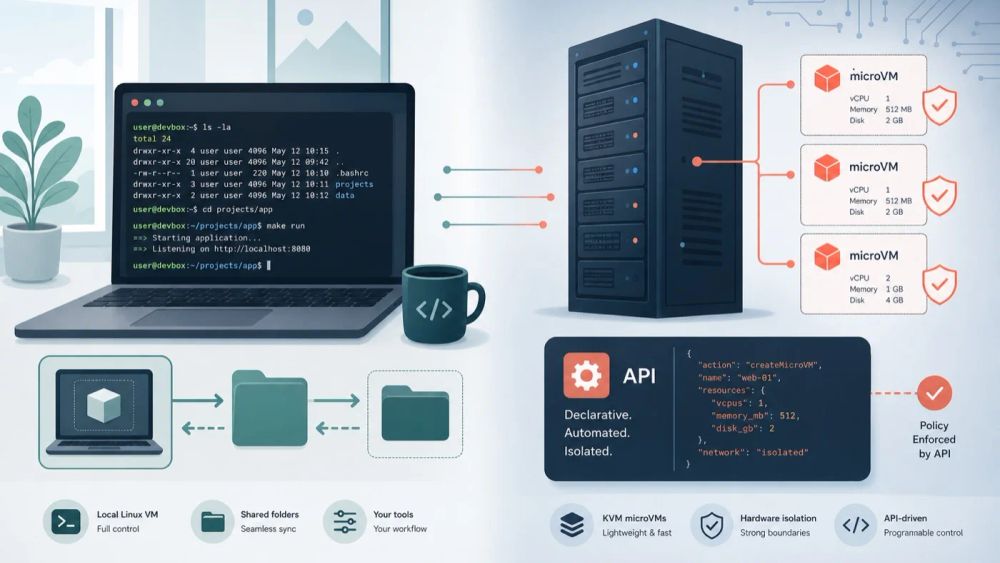
People say “VM” for both Lima and Firecracker, but the two projects answer different questions. Lima is a local Linux VM manager: shared folders, forwarded ports, templates for Docker and Kubernetes, and documented vmType drivers (QEMU, Apple Virtualization.framework via vz, WSL2 on Windows, plus Krunkit marked experimental for some Apple Silicon setups) depending on the host (VM types, Krunkit). Firecracker is a Rust VMM on Linux KVM that runs one microVM per process, with a minimal VirtIO device model, an in-process HTTP API, and a security story built around seccomp, cgroups/namespaces, and the jailer helper (design overview).
This post compares them as categories of tooling, not as interchangeable products. For hands-on detail, see Lima: Linux VMs with shared folders, Firecracker microVMs: KVM isolation, and the broader devbox ladder—plus dev-ore devbox for a published Lima template set aimed at disposable local clones.
What you are actually comparing
Lima optimizes developer ergonomics on non-Linux or Linux desktops: one or a few long-lived guests, editing on the host, executing in Linux, often with containerd/nerdctl or Docker templates (Lima README).
Firecracker optimizes secure, high-churn execution on Linux servers: hardware-backed isolation with startup and memory footprint tuned for serverless-style workloads rather than for a comfortable desktop shell session (Firecracker README).
So the real decision is usually “desktop Linux environment” versus “minimal KVM guest as a security boundary”—not “which QEMU alternative wins.”
Host matrix: where each can run
| Dimension | Lima | Firecracker |
|---|---|---|
| Typical hosts | macOS, Linux, Windows (WSL2 path) (VM types) | Linux with /dev/kvm and hardware virtualization (getting started) |
| Apple Silicon / Intel Mac | Lima steers macOS toward vz or QEMU in its vmType flowchart; Krunkit is documented for Apple Silicon but labeled experimental (VM types, Krunkit) | No—Firecracker expects Linux KVM (/dev/kvm), not macOS hosts (getting started) |
| Primary hypervisor API | QEMU (Lima’s flowchart default path on Linux), vz / Virtualization.framework and QEMU on macOS, WSL2 on Windows, optional Krunkit (experimental) | KVM only |
If your laptop is a Mac and you need a Linux environment tomorrow, Lima (or a Lima-based wrapper) is on the short list; Firecracker is not unless you move the workload to a Linux machine or a provider that already runs Firecracker for you.
Guest model: general-purpose VM vs trimmed microVM
Lima boots normal Linux machine images with enough legacy and VirtIO plumbing that day-to-day dev expectations (filesystem mounts, port forwards, SSH-style access, varied templates) stay tractable. Upstream docs state vmType can only be set when the instance is created—it cannot be changed afterward (VM types). On macOS, Lima v1.0+ defaults new instances to vz when compatible (earlier releases defaulted differently); the flowchart still routes some cases to QEMU (VM types).
Firecracker deliberately exposes a small device surface compared with QEMU-class stacks—the FAQ’s “Firecracker vs QEMU” answer lists six guest-visible pieces (virtio-net, virtio-balloon, virtio-block, virtio-vsock, serial console, and a minimal keyboard controller the FAQ describes as used only to stop the microVM), characterizing that as excluding non-essential PC machinery (FAQ). The README is the place to cross-check current API-driven capabilities, which can extend beyond that short FAQ list (README feature list). That footprint is a fit for controlled images and automation; it is the wrong target if you wanted a clicky desktop VM with broad device support.
The same FAQ answer claims < 125 ms guest startup time and < 5 MiB memory footprint, tying those numbers to the trimmed device model and streamlined kernel loading wording there—not to a measurement from this site (FAQ: Firecracker vs QEMU). Treat them as upstream-reported figures that will depend on kernel, rootfs, host, and configuration; Lima does not publish an equivalent bar because its goal is fidelity and integration, not minimizing per-sandbox churn on a busy host.
Control plane: CLI templates vs HTTP API
Lima is driven by limactl, YAML templates, and lima … command forwarding—a workflow aligned with individual engineers and local iteration (getting started).
Firecracker is driven by an OpenAPI-described HTTP API (the upstream FAQ calls it a RESTful control API) served in-process (see the OpenAPI spec and API docs in the upstream repo). Operators combine that with host-side TAP bridges, disk files, filtering, and jailer-style launches (design: sandboxing).
You can connect Firecracker to containerd (firecracker-containerd) or hide it behind Kata Containers (project home), but that is already platform engineering—not the same commitment as brew install lima && limactl start.
Threat model and blast radius
Lima gives you a separate Linux kernel from the macOS or Windows host, which closes a large class of “container breakout → host kernel” worries that matter when toolchains are exotic and daemons listen on ports. It does not, by itself, turn your laptop into a multi-tenant public cloud; misuse of directory sharing, forwarded ports, and guest networking can still leak data or expose services.
Firecracker assumes guest vCPUs are malicious after boot and emphasizes defense in depth on KVM: controlled data paths, rate limits, and explicit guidance that egress filtering is the host’s job (design: threat model). That posture matches short-lived tenants and automation, not your personal dotfiles machine.
When Lima is the better fit
- You develop on macOS or Windows and need Linux with shared source trees and simple port publishing.
- You want Docker / nerdctl / Kubernetes templates without hand-rolling cloud-init for each teammate (templates narrative).
- Boot time and RAM per sandbox matter less than interactive convenience and familiar VM semantics.
When Firecracker-class microVMs are the better fit
- The workload runs on Linux with KVM, and you need many short-lived guests or VM-grade isolation for untrusted code (design goals).
- You are building or buying a platform (serverless workers, sandboxes, CI isolation) where API-driven lifecycle and minimal device attack surface beat desktop polish.
- You will invest in host hardening and integration (networking, images, kernel policy—see kernel policy and production host setup).
About “running Firecracker from Lima”
Upstream Lima’s documented vmType values are QEMU, vz, WSL2, and Krunkit—not Firecracker (VM types). The docs also describe experimental paths and custom drivers for contributors (Virtual machine drivers). Treat Firecracker-as-a-Lima-backend as non-standard unless you own the integration; it is not the default mental model for either project.
Conclusion
Lima and Firecracker both use virtualization, but Lima sells integrated Linux VMs for desktop development across macOS, Linux, and Windows, while Firecracker sells KVM microVMs for Linux host platforms that need API-controlled, minimal, high-churn guests. Choose Lima when the problem is your environment; choose Firecracker (often indirectly, via a runtime or cloud) when the problem is someone else’s code at scale.
If you want a single ladder that also names OCI images and LXC, keep VMs, Linux boxes, and OCI for an AI coding devbox as the map—this article is only the Lima-vs-Firecracker slice.
Agent-facing stack on top of whichever side you picked: Pi (minimal terminal harness), Archon (YAML workflows across worktrees), Varlock (@env-spec + varlock run), cmux (macOS multiplexed shells), Terax (integrated GUI terminal)—none of those replace kernel boundaries, but they dictate how often you collide with mounts, ports, and secrets.